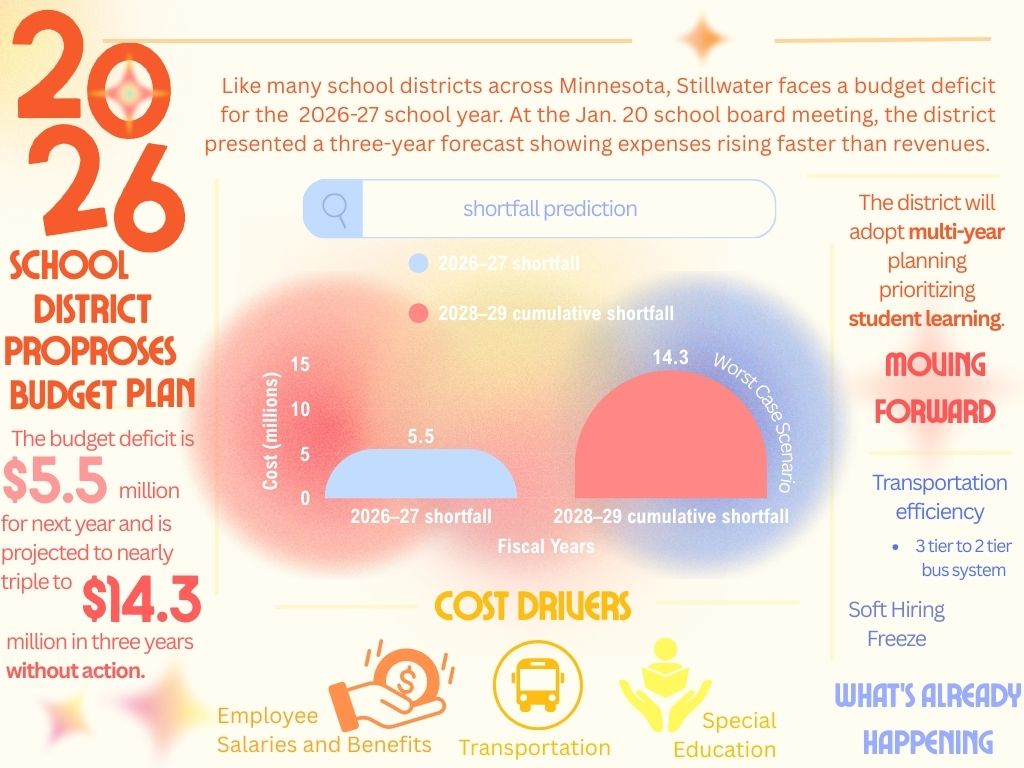

For the incoming school year, the Stillwater Area School District transportation model will change drastically. To combat the $5.5 million budget shortfall, the district hopes to close the gap by cutting the number of buses being used. The new model will have “bussing hubs,” at elementary schools. One bus will go through a neighborhood and collect all students from all grades, from there the elementary schoolers will be dropped off first and the middle and high schoolers will be transferred to a different bus to get to school.
The new bus system is designed to save the district almost half a million dollars in transportation costs, as many of the busses being used by the district are almost half empty.
“The district right now is paying around $14 million for transportation, and the district needs to cut $5 million somewhere.” Pete Kelzenberg, school board member and bus driver said. “They’re thinking they could save probably around half a million dollars, a little bit more than $600,000 if they make these transportation changes,”
Since announcing these changes, parents and students have expressed concerns over elementary schoolers riding the bus with high schoolers. Many are anxious about the younger students being exposed to harsh language, and substance problems.
Eighth grader Aiden Kinney expressed his concern, “it will show [the elementary students] stuff they shouldn’t see, like drugs and vaping.”
According to the Center for Disease Control, 7.8% of high schoolers in the USA are currently using e-cigarettes, along with 3.5% of middle school students who reported use. “It is a legitimate concern [mixing] big and little kids, but we do it right now for St Croix Prep, there’s middle schoolers all the way through with the high school kids,” Kelzenberg said. “A kindergartener is more likely to hear the truth on Santa Claus from a fifth grader than from a high school kid.”
The “bussing hub” system may be confusing for elementary students, and many are worried about the younger students getting mixed up when students are transferred from one bus to another.
“As much as we try to make things streamline, you’re still going to have kids who don’t know exactly what’s going on, and you can’t watch every single kid,” sophomore Everett Bye explained.
The goal of the new model is to fill up the busses as much as possible and to decrease the amount being used. Currently, the district has multiple unfilled busses going into neighborhoods to pick up students. This sparks a concern over that crowded busses will contribute to increased behavioral issues.
“You can’t just throw them into a bus with a bunch of different ages and personalities, I feel like we’re going to have some problems there,” Bye added.
This generates the question on whether bus drivers will be able to control the influx of kids, of all different ages. Kelzenberg described how bus drivers “have the mirror. If there is conflict, they pull over.” He added, “If it really got severe, they would pull over and police would be called. That has happened, but it is so unusual.”
Another issue concerning families is that many students who live near the school will no longer receive bussing and will be moved to “walk zones.” This means that elementary students who live within half a mile of the school will not be able to have a bus stop, as well as secondary students within two miles of their school. Additionally, students will only be able to have one morning bus stop, and one afternoon bus stop. This limit will greatly affect families and students who live in two different homes, as students will not be allowed to have more than one bus stop in the coming year.
“Mom and Dad really ought to sort that out rather than the district. So, you can’t really take up two spots, if we have the room, great, but we might not have the room if we get really efficient to fill up the bus,” Kelzenberg added.
The district making these changes has generated debate surrounding whether or not students are being adequately supported, Bye said he “feels like there is a lot of focus on money.” As well as he “doesn’t think there is enough effort to understand what the average student is doing, because usually when we talk about the school board, nobody’s happy.”
The change to the transportation model will require a transition period for all students and families. The district has said they are “committed to providing safe, efficient transportation in compliance with Minnesota state laws, rules, and regulations.” Additionally, The school board holds meetings the third Tuesday of every month and are open to the public.