

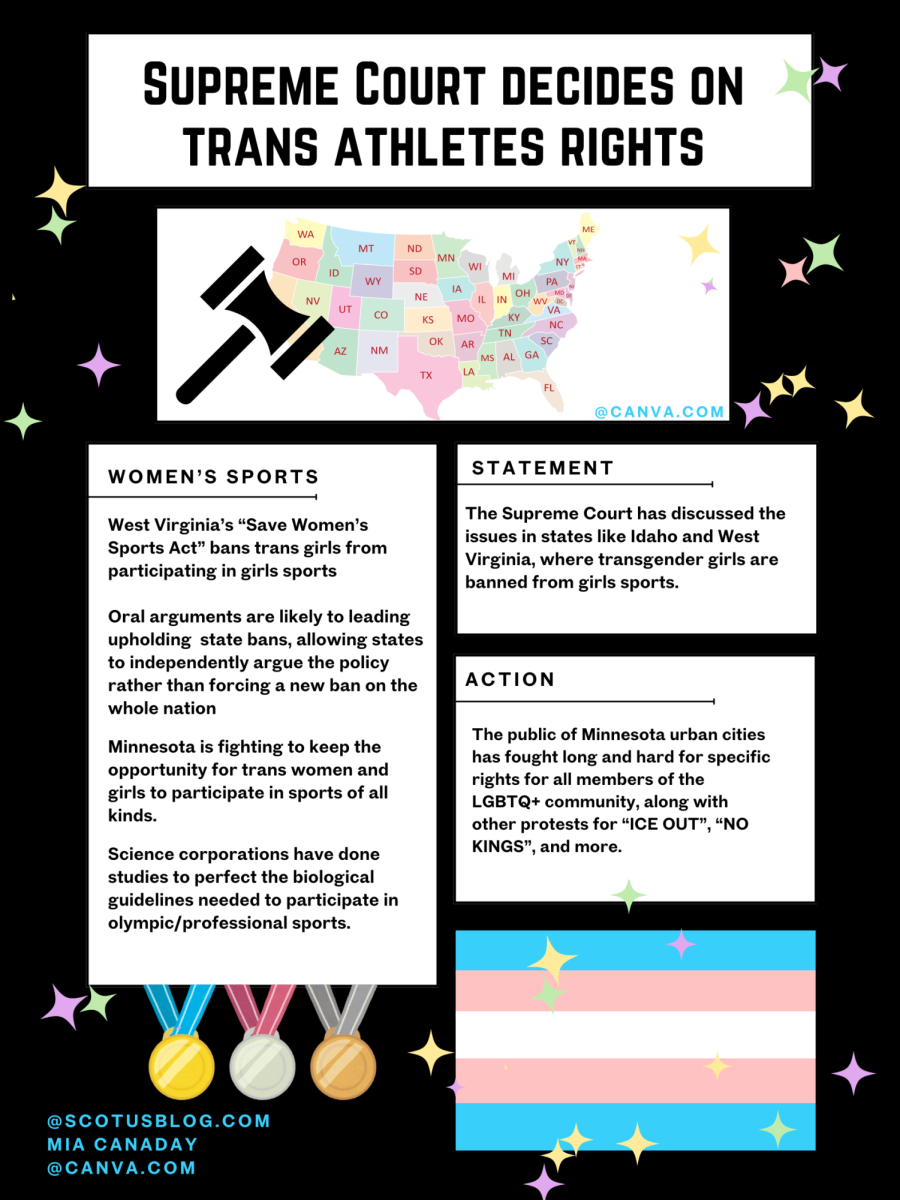
Transgender athletes may have their right to play sports taken away. Minnesota is doing its best to support trans-inclusive sports by fighting those who try to stop trans people from participating. On Jan. 26, Minnesota planned to bring the Department of Justice (DOJ) into the fight. Minnesotans should help trans-athletes earn their rights back and support them along the way.
If Minnesota does bring in the DOJ for help to fight between Trump’s administration, it could result in the termination of Minnesota’s federal funding.
Minnesota solicitor general Liz Kramer previously said the “federal government would need to follow an extensive, multi-step administrative process before any federal funding to Minnesota’s education system could ever be terminated.”
Minnesota and the civilians that live there should take that next step to win this fight against Trump’s administration by including the DOJ and risking losing their federal funding. In turn, this will show other states that we support transgender athletes, and maybe other states will start to support them too.
Minnesota receives about 10%, or $1.4 billion, of its annual school funding from the federal government, while the other 90% of that comes from local property taxes and state aid.
The money that Minnesota receives “pays for a variety of programs from services for students with disabilities to support for English language learners to school breakfast and lunch,” Star Tribune’s Joe Christensen said.
If Minnesota wants to support its athletes, it should fight for them and show how much it cares for its citizens. If Minnesota loses that 10%, it is a strong state and can move funding around to figure out how to support everything and everyone.
Organizations like the NCAA and International Olympic Committee have used science-based guidelines to develop a plan to ensure fairness and opportunities for over a decade. The understanding that transgender athletes are as capable as athletes is shown by the NCAA, which allows them to play.
It is important that trans-athletes should have a way to “pursue sports and have an opportunity to participate,” counselor Sydney Piras said.
For many years, big-name sports committees and businesses have used science-based guidelines to make sure that everyone who is playing has a fair experience and has the chance to play the sport they are interested in.
Transgender athletes represent a tiny fraction of competitors, and their inclusion has not negatively affected women’s sports. In fact, they have increased participation and watch time of women’s sports.
“When I last looked at the NCAA, there were like 11 athletes, which is around 0.02% of the total athletes,” Piras added, which shows that even though there are minimal amounts of transgender athletes, there is still a bad reputation towards them in sports.
Even though there has been misinformation about transgender athletes, there is no solid proof that letting transgender people play sports has affected or made the sport they are playing unfair for others.
Minnesota should continue to support trans-inclusive sports, and People should realize that many sports committees have rules and regulations to make sure that fairness is still maintained. The school districts should support the ideology of allowing transgender athletes play in sports because it will increase participation in girls sports.